 English
 Español
 Deutsch
 Français
 Svenska
 Dansk
 Norsk
 Nederlands
 Polski
 Čeština
 Português
 Ελληνικά
 Italiano
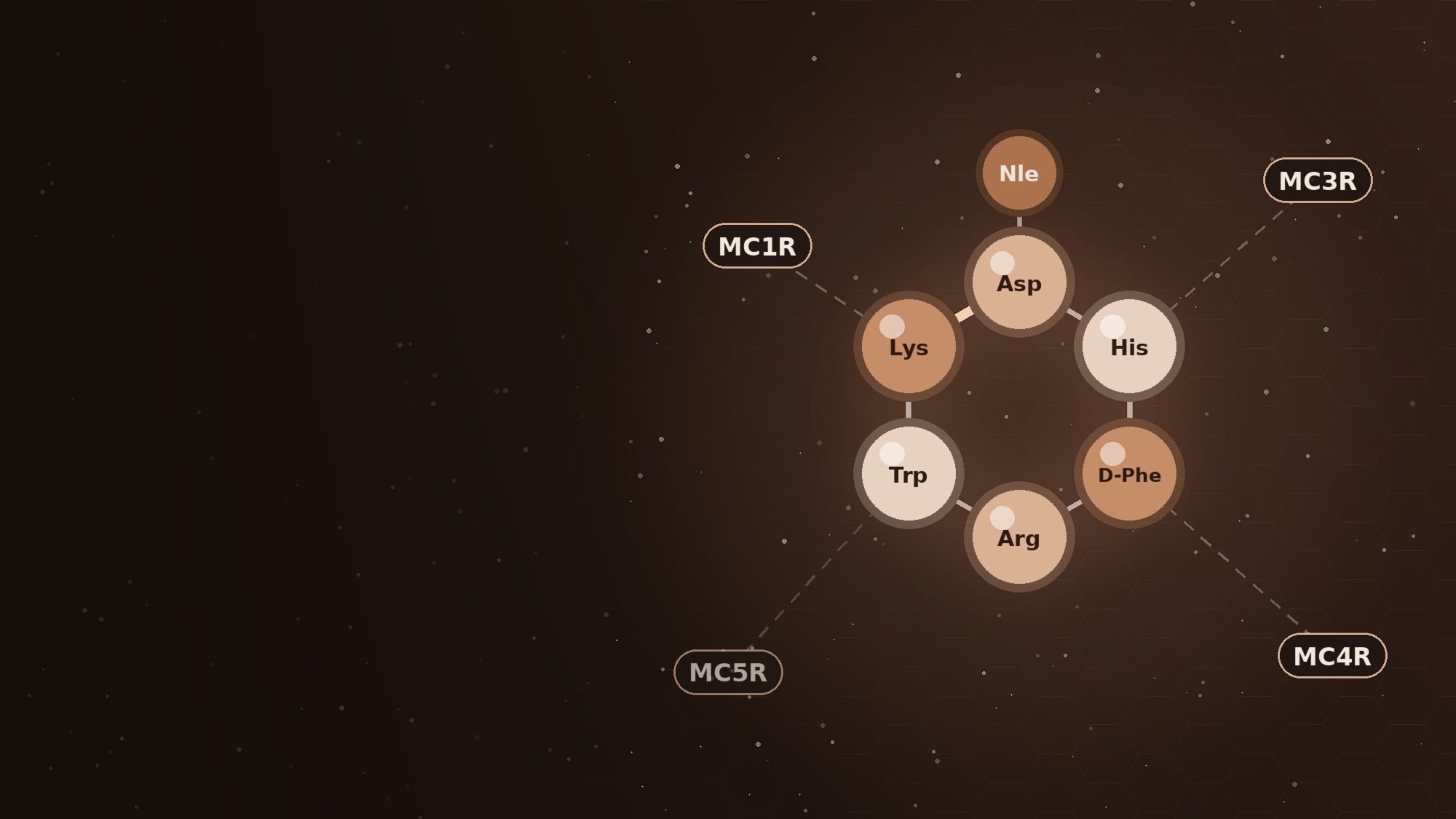
Melanotan 2 is a short synthetic peptide folded into a ring. Designed at the University of Arizona in the late 1980s, it switches on most of the body's melanocortin receptors at once, which made it a standard tool in receptor and brain research. This site explains the molecule, its family tree and why regulators keep warning about it.
Melanotan 2, usually shortened to MT-2 or MT-II, is a laboratory-made peptide modelled on the central part of alpha-melanocyte-stimulating hormone (α-MSH). Its chemists closed the chain into a ring with an amide bridge between two side chains. That small change made the molecule far sturdier and more potent than the stretch of natural hormone it imitates.
What pharmacologists value in Melanotan 2 is that it is not selective. It activates the MC1, MC3, MC4 and MC5 receptors, a family involved in pigment cells, inflammation and the brain's regulation of energy balance. For three decades it has served as a reliable way to switch these receptors on in cell and animal experiments, often next to its blocking counterpart SHU9119.
This guide treats Melanotan 2 as what it is on paper: a research compound. It has never been approved as a medicine, it is sold online in ways that regulators have repeatedly warned about, and its effects in people come mainly from a few small studies in the 1990s and from case reports. We explain how it was designed, how it relates to afamelanotide and bremelanotide, and what doctors have reported.
| Type | Synthetic cyclic heptapeptide, an analogue of α-MSH |
| Structure | Ac-Nle-cyclo[Asp-His-D-Phe-Arg-Trp-Lys]-NH2 |
| Formula and mass | C50H69N15O9, about 1,024 g/mol |
| Receptor profile | Agonist at MC1R, MC3R, MC4R and MC5R; no action at MC2R, the ACTH receptor |
| Origin | University of Arizona, Tucson, described in 1989 |
| Close relatives | Afamelanotide (Melanotan 1) and bremelanotide (PT-141), which was derived from it |
| Regulatory status | Not approved as a medicine in any country; warnings issued by several regulators |
Melanotan2.xyz explains research and regulation. It does not recommend using Melanotan 2, which is a laboratory chemical and not a medicine. If you have a question about your own health, please ask a doctor or pharmacist.